
Yuba Parole vs Probation
Parole and probation are both post-release supervision terms, but they come from different sources. In a Yuba County case, probation is usually imposed by the court and supervised locally by Yuba County Probation. PRCS, or Post Release Community Supervision, can apply after certain state-prison releases under California realignment and may be handled by the county. State parole is tied to CDCR release and supervised through CDCR Division of Adult Parole Operations.
| Status | Who supervises it | Best verification path |
|---|---|---|
| County probation | Yuba County Probation Department | Yuba court order, probation office contact, Criminal Division record. |
| PRCS | County-level supervision after qualifying prison release | Release paperwork, Yuba Probation, CDCR release processing records. |
| State parole | CDCR Division of Adult Parole Operations | DAPO Northern Region, BPH records, CDCR records, parole agent contact. |
| No supervision | No active supervising agency shown by the record | Court disposition, jail release record, and agency confirmation. |
- Probation
- A court-ordered supervision term that may follow jail release or replace more jail time.
- Parole
- State supervision that commonly follows release from CDCR prison custody.
- Discharge
- The end of supervision when the person is no longer under that parole, probation, or PRCS term.
Verify Yuba Post-Release Supervision
A supervision check should start with the order that created the supervision. A person released from Yuba County Jail may have no supervision, county probation, PRCS, a pending court case, or a transfer to another agency. A person released from CDCR may have state parole, PRCS, or another release condition. Do not infer supervision from a roster absence. Use the record path first, then the supervising office.
- Check the Yuba Superior Court case for sentence, probation order, release order, dismissal, or future hearing.
- If the record points to local probation or PRCS, contact Yuba County Probation with identifying details and the case number if known.
- If the person came from CDCR, check CIRIS if they may still be in custody and then use DAPO or CDCR records for parole status.
- For BPH cases, search hearing schedules and results, then remember that a grant is not instantly final.
- Use the Sheriff's release record to confirm the jail release date and release type when the custody event is local.
The full Yuba County released-inmate search path is useful when the case path is unclear. It separates jail, court, CDCR, VINE, BOP, ICE, and records-request channels before supervision is checked.
Yuba Probation Office Detail
Yuba County Probation is the named local supervision office in the research. The department's mission page says it promotes community health and safety through prevention, intervention, treatment, and detention services. It also lists risk and needs assessment, enforcement of court orders and sanctions, prevention and intervention work, treatment collaborations, and victim-rights functions. That makes it the correct local contact when the court ordered probation or when a state release is placed on county PRCS.
Yuba County Probation Department
215 5th Street, Suite 154
Marysville, CA 95901
(530) 749-7550
Fax: (530) 749-7364
Monday-Friday, 8 a.m. to 5 p.m.
CDCR Adult Parole
Northern Region directory and field-unit contacts
The local office address also matters because the jail, court, and probation office sit in the same Marysville courthouse-area ecosystem. That does not mean one counter can release another agency's record. It means the correct office should be matched to the record type before visiting.
Yuba Parole Hearing Records
For state-prison cases, parole may involve the California Board of Parole Hearings. BPH conducts parole suitability proceedings and nonviolent offender parole reviews for incarcerated adults under CDCR jurisdiction. Its hearing schedule page says schedules include date, time, location, and whether the hearing is in person or by video conference, and that schedules are updated weekly every Thursday morning.
BPH results use precise outcome terms. A grant means the person was found suitable and recommended for release to parole, but the decision remains subject to legal review and possible Governor review before finality. Deny, continue, cancelled, split, postpone, waive, and stip each mean something different. Do not collapse every BPH event into a release. Use BPH hearing schedules, BPH hearing results, and CDCR parole channels together.
The manifest includes the BPH parole eligibility screenshot tied to parole and release-date terms.
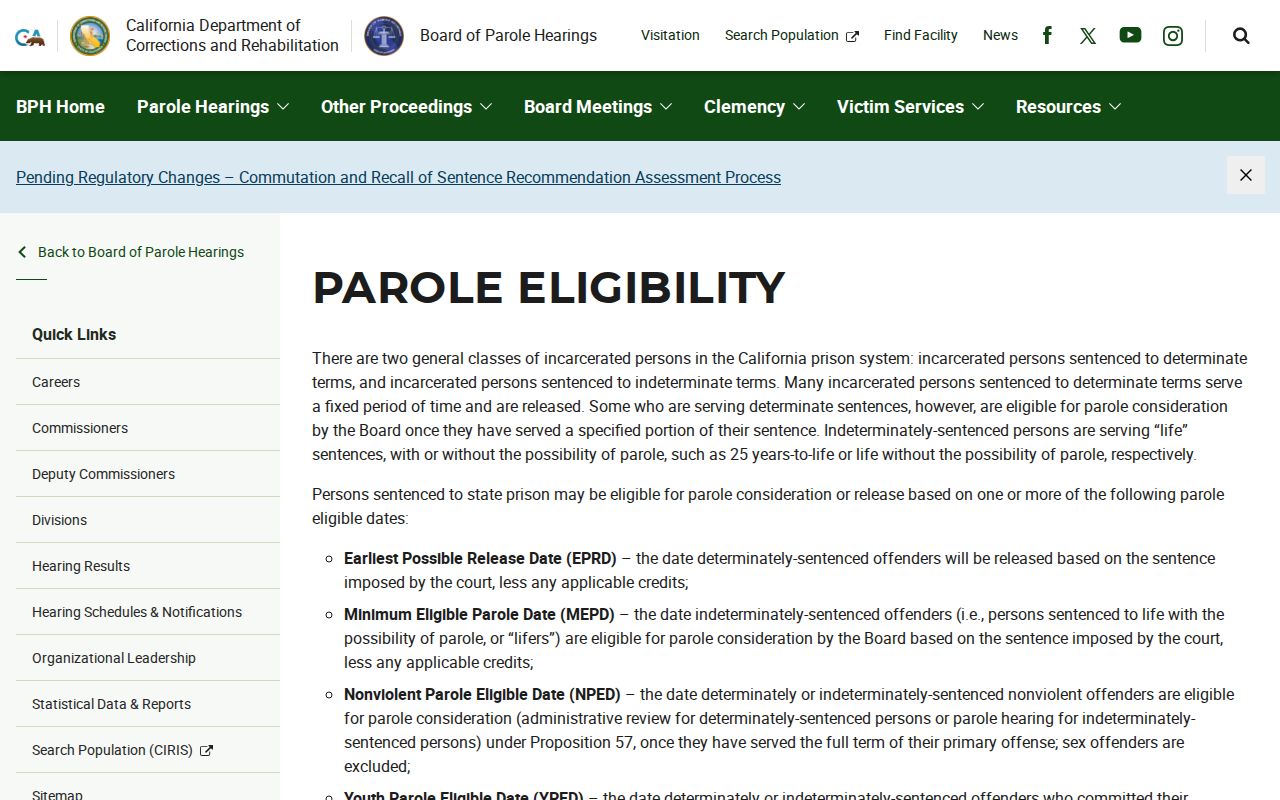
Those terms help separate a future parole eligibility date from an actual release to supervision.
Yuba Warrants and Absconders
Conditions are the rules attached to supervision. A violation is an alleged breach of those rules. An absconder is generally a supervised person whose whereabouts or reporting status is a supervision problem, but the exact status must come from the supervising agency or a court record. No official Yuba County probation absconder list was found in the reviewed sources. CitizenRIMS may have law-enforcement modules in its wider system, but the research did not establish a Yuba probation absconder page.
For local issues, use court records, official sheriff warrant channels if visible at capture time, and direct agency contact. For state parole warrants, use DAPO or law-enforcement confirmation. VINE can help with custody changes if a person is returned to custody, but it does not replace the court or supervision file.
Yuba Reentry Program Context
Yuba County Jail publishes a local programming landscape that gives context to release and supervision, without proving any one person's status. The jail describes programs including GED, life skills, janitorial certification, construction, alcohol and drug counseling, anger management, stress management, work programs, work furlough, and weekender programming. These are jail-administered programs and transition context, not proof of probation or parole.
Work furlough needs careful wording. A person in work furlough may leave for approved work and return under jail rules. That is not the same as full release from the case. The work furlough page says participants must make their own transportation arrangements and generally must work in Yuba County or Sutter County unless an exception or reciprocal arrangement applies.
Yuba Property After Release
Supervision often begins after the jail release, but release-day property issues are separate. Yuba's commissary and property page says property released by an inmate may be picked up 24 hours a day at the Jail Lobby with valid ID. It also says an inmate separated from the jail who was charged for commissary not received may return on Wednesdays between 2:00 p.m. and 3:00 p.m. to claim it, and unclaimed commissary is held only 90 days.
Those rules matter for people closing out a jail stay before reporting to probation, PRCS, or parole. They do not decide supervision status. Use the release record and court or agency record to answer supervision, and use the jail's property rules to handle property or commissary.
Yuba Supervision Discharge
Supervision ends through discharge, termination, expiration, court action, or agency action, depending on the type of supervision. County probation should be checked through the court record and Yuba Probation. PRCS should be checked through county supervision and release documents. State parole should be checked through CDCR DAPO, BPH where applicable, and CDCR records. A jail release record tells when custody ended at the jail, but it does not always show when parole, probation, or PRCS later ended.
California public-record rules can support records requests, but access may be limited by confidential, sealed, juvenile, or other restricted records. The safe request is specific and purpose-neutral: ask for the record that shows supervision status or discharge, identify the person and case if known, and ask the agency to cite any withholding basis if it cannot release a field.