
BPH Release Decisions
The California Board of Parole Hearings conducts parole suitability proceedings and nonviolent offender parole reviews for incarcerated adults under CDCR jurisdiction. It is a release-decision body, not a jail, parole office, or county records desk. For a Yuba County person serving a state-prison sentence, BPH may explain whether parole was considered, granted, denied, postponed, or otherwise changed before release.
The research found two key public BPH paths: hearing schedules and hearing results. The schedule page says hearing schedules include date, time, location, and whether the hearing is in person or by video conference, and that schedules are updated weekly every Thursday morning. The results page provides weekly and monthly outcomes and defines result terms. A grant should not be treated as an instant walk-out. It can remain subject to legal review and, where applicable, Governor review.
| BPH result | Plain meaning for release research |
|---|---|
| Grant | Found suitable or recommended for parole, subject to required review |
| Deny | Not found suitable for parole at that proceeding |
| Continue or postpone | Hearing did not create a final release outcome that day |
| Cancelled, waive, stip, split | Specific procedural outcomes that should not be collapsed into released |
Confirm a BPH Release
BPH records are strongest when the person is in CDCR custody or recently went through a parole-suitability process. They do not confirm a Yuba County Jail bail release, a local probation case, or a federal release. Start with the custody type. If the person was sentenced to state prison from Yuba County, search CDCR and BPH. If the person was released from the county jail without a prison sentence, use Yuba jail, court, VINE, and Records paths instead.
- Use CIRIS to see whether the person is currently in CDCR custody and whether BPH dates or outcomes appear.
- Search the BPH hearing schedule for upcoming proceedings if the case is still pending in prison.
- Search BPH hearing results for recent or monthly outcomes.
- Read the outcome term carefully. A grant, denial, postponement, and waiver mean different things.
- Use DAPO parole, CDCR records, or Yuba court records to confirm the actual release or supervision phase.
The BPH parole eligibility page defines EPRD, MEPD, YPED, and EPED, which helps explain why a person may have an eligibility date without an actual release.
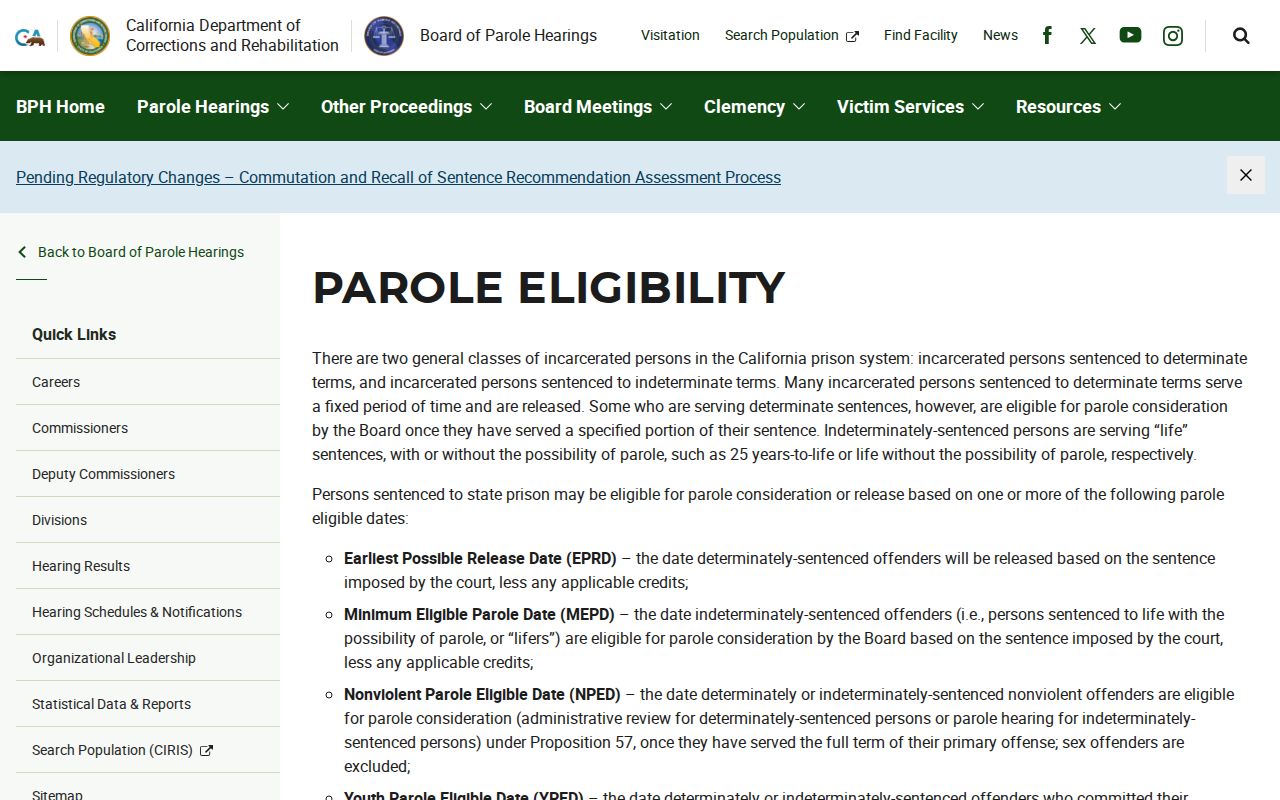
The eligibility terminology is useful for Yuba County cases because it separates a date for possible consideration from a confirmed release event.
BPH Records and Contact
The research gives the Board of Parole Hearings mail address, phone, correspondence email, and public-records request email. Use BPH for parole hearing schedules, results, and board records. Use CDCR for custody and release processing. Use DAPO for supervision after state parole begins. Use Yuba Superior Court when the local sentence, abstract, resentencing, or minute order is the source of the state-prison release path.
Board of Parole Hearings
P.O. Box 4036
Sacramento, CA 95812-4036
916-445-4072
BPH.CorrespondenceUnit@cdcr.ca.gov
BPH Public Records
Public records request email
m_BPHPRARequests@cdcr.ca.gov
Use for BPH records, not county jail release records.
About California BPH
BPH is part of the state-prison release decision structure. It handles parole suitability proceedings, nonviolent offender parole reviews, medical parole proceedings, offender mental health disorder reviews, sexually violent predator review work, clemency-related investigations, and foreign-prisoner transfer matters. For Yuba County release research, the key point is narrower: BPH may show a release path for certain CDCR prisoners, especially life-term or parole-suitability cases.
A Yuba County jail release and a BPH parole decision can both involve the word release, but they are different records. The jail release record answers how someone left county custody. BPH answers what happened in a state parole proceeding. DAPO answers supervision after state parole. The court may explain the sentence that placed the person into CDCR in the first place.
BPH Schedules and Results
The hearing schedule is useful before a decision. It can show the hearing date, time, prison location, and hearing format. The result page is useful after a proceeding. It can show whether the board granted, denied, continued, cancelled, split, postponed, waived, or stipulated the matter. Users should record the date and exact outcome term, then follow the agency path that matches the term.
For a grant, do not call the person released until the actual release or parole phase is verified. Use DAPO, CDCR records, or court follow-up. For a denial, the person generally remains in custody unless another release basis applies. For a postponed or continued matter, the release question is still unresolved through that hearing.
The Thursday update cadence also matters for timing. A hearing may occur before the public results page reflects the outcome, so the schedule, result, and custody record may briefly point to different stages.
Yuba County BPH Use
If a person from Yuba County was sentenced to life with the possibility of parole or another CDCR sentence reviewed by BPH, the county jail page is not the release source. Search CIRIS for current custody, BPH schedules for upcoming hearings, and BPH results for outcomes. If a grant appears, confirm whether review periods, Governor review, and parole processing have resolved.
If the person was never sent to CDCR, BPH will usually be the wrong system. A local bail release, own-recognizance release, dismissal, county jail time-served release, or local probation case belongs in Yuba jail, Records, court, VINE, and probation channels.
BPH is most useful when the public already knows the person is in CDCR or has a CDCR number, prison location, BPH date, or indeterminate sentence. Without that state-prison link, the board's schedule and results can create false matches. Yuba court records and CDCR fields should be used first to connect the person to the correct state case.
After a BPH Grant
A grant in BPH results is a major release clue, but it still has to be placed in the state release process. CDCR may need to process records, review detainers, assign a parole or PRCS office, draft conditions, handle required notices, and confirm release funds. Those steps explain why a BPH outcome, a CDCR custody status, and a parole office record may not appear to match on the same day.
For Yuba County research, the follow-up depends on the supervision route. If the person is released to state parole, DAPO is the supervision contact. If the person is released to PRCS, Yuba County Probation may be the local contact. If a court resentencing order drove the release, the Yuba Superior Court record should be checked with CDCR records before calling the process complete.
Public Record Search
Sponsored Results